
Blog
Yard Debris Removal Cost in Hampton Roads: What Affects the Price and How to Get a Fair Quote
Learn what drives yard debris removal costs in Hampton Roads, when free curbside pickup is enough, and how to get an accurate same-day quote.
You get a quote for yard debris removal, accept it because the number looks reasonable, and then the crew leaves half the pile sitting in your yard. It happens more often than it should, and in most cases, it comes down to one thing: the homeowner had no way to evaluate whether the quote was accurate in the first place.
Yard debris removal cost in Hampton Roads is not a flat fee. What you pay depends on how much debris you have, what kind it is, how easy it is to access, and when you need it gone. A small leaf cleanup costs far less than hauling away storm-damaged tree limbs, and a backyard with a narrow gate costs more to service than an open front lawn.
This post breaks down every variable that drives the price of yard waste removal in Hampton Roads. You will learn when free municipal pickup is a legitimate option, what separates an accurate quote from an underbid one, and how to ask the right questions before hiring anyone. By the end, you will be equipped to compare services with confidence, not just go with the lowest number.
Start Here: Free Curbside Pickup vs. Hiring a Private Yard Debris Removal Service
Before spending a dollar on yard debris removal, check what your municipality already covers.
Hampton provides free curbside bulk limb pickup on your regular collection day, with strict rules attached. Limbs must be no larger than 6 inches in diameter and no longer than 8 feet in length. Placement timing is non-negotiable: set debris out no earlier than 3 p.m. the day before and no later than 7 a.m. on collection day. Miss that window and the truck passes without stopping.
Leaves and grass clippings follow a separate rule entirely. Hampton requires both to be bagged in clear plastic bags so collectors can verify the contents before loading. Contractor bags, black trash bags, and loose curbside piles are all rejected outright. Virginia Beach similarly includes yard debris in its standard curbside collection services.
Municipal pickup is genuinely useful for small, compliant loads generated by routine yard maintenance. It stops working when volume climbs, when debris is oversized, when your property layout makes curbside placement impractical, or when a storm drops material faster than a weekly pickup schedule can handle. For a closer look at where these limits typically surface in Hampton Roads, see why municipal pickup often falls short for larger jobs.
That gap between what free service covers and what it cannot is exactly where private yard debris removal becomes worth evaluating. That decision is the starting point for everything else in this guide.
Why Yard Debris Removal Has No Standard Flat Rate
Once you decide private removal is the right call, the next question is obvious: what will it cost? No reputable yard debris removal service in Hampton Roads posts a price list online. That isn't evasiveness; it reflects how genuinely unpredictable this work is.
Lawn mowing can be priced by square footage because the variables are limited. Debris removal cannot. Volume, debris composition, access conditions, and timing all shift independently on every job. A site assessment isn't a sales tactic; it's the only honest way to price the work.
Quote-based pricing is the market standard here. A published rate would either overcharge straightforward cleanups or lose money on complex ones.
Debris composition illustrates the problem. A single truckload of clean, dry brush loads quickly and routes to a standard yard waste facility. A mixed pile of storm debris, wet leaves, soil, and concrete fragments requires sorting, takes longer to load, and often cannot go to the same disposal site. Understanding what's in your pile matters before any number gets attached to it. For a fuller breakdown of what the removal process involves, What Is Included in a Professional Yard Debris Removal Service is worth reading before you call anyone.
The risk to watch for: some services advertise a flat rate to win the bid, then quietly leave behind debris that pushes the job past the implied scope. The lowest number is only a good deal if it covers the entire job.
Debris Volume: The Biggest Driver of Yard Waste Removal Cost
Of all the variables that shape yard debris removal cost, volume is the one that moves the price the most. Providers measure it in cubic yards. One cubic yard is a 3-foot cube, roughly the size of a standard washing machine. A standard full-size pickup truck bed holds about 2 cubic yards when loaded level; short-bed trucks hold closer to 1.5.
That scale matters across real jobs. A routine cleanup of trimmed shrubs and bagged leaves typically generates 2 to 4 cubic yards. A full-season leaf cleanup or post-storm property can push 10 to 20 cubic yards, requiring multiple truck runs.
Most professional services price in load tiers rather than exact cubic yardage. Crossing into a second load tier is where quotes shift significantly.
Compaction complicates the picture. Wet, dense debris like sodden leaves or matted grass occupies more truck space per pound than dry, airy brush. A pile that looks manageable can fill a truck faster than expected when waterlogged, potentially pushing a job from one haul into two.
When requesting a yard waste removal cost estimate, concrete descriptions help. Note how many piles, their approximate dimensions, and how many bags are involved. Vague descriptions give providers reason to pad quotes for uncertainty. If you are weighing how much effort to put into cleanup before calling, this honest comparison of DIY fall cleanup versus hiring a pro is worth a look first.
Debris Type: Why Tree Debris Removal Cost Differs From Leaf or Grass Cleanup
Volume tells you how much you're moving. Debris type determines how hard it is to move and where it can legally go.
Clean yard waste, leaves, grass clippings, and small trimmings, sits at the lowest end of the cost spectrum. It compacts predictably, qualifies for Hampton's dedicated yard waste facility and similar composting programs, and moves quickly, keeping labor and disposal costs down.
Tree debris is a different calculation. Large limbs and trunk sections must be cut to manageable lengths before a crew can safely load them. That added labor, combined with heavier haul weight, is why tree debris removal cost runs higher than a comparable volume of leaves or brush.
Mixed debris raises the stakes further. When yard waste is combined with soil, rocks, concrete, or construction material, the entire load loses eligibility for yard waste recycling facilities. That forces disposal through a commercial landfill route, which costs more and takes longer to arrange. A load that could have gone to a composting site becomes a landfill haul the moment contamination enters the pile.
Stump grindings and root balls occupy their own category. Dense, heavy, and awkward to handle, they are rarely included in a general haul quote and typically appear as a separate line item.
Before calling for a quote, identify which category describes your debris. Knowing whether you have clean brush, tree limb sections, or a mixed pile gives any provider the context to price accurately. For situations involving fallen trees or storm damage, what storm debris cleanup includes is worth reviewing before you call.
Property Access: The Hidden Cost Factor Most Quotes Overlook
Debris type tells you what you're hauling. Access tells you how hard it is to get there, and that distinction quietly drives cost in ways most phone quotes never capture.
Debris staged at the curb or on a driveway apron is the easiest scenario: a crew loads directly into the truck with minimal carry distance. Move that same debris behind a fence, down a slope, or through a gate barely wide enough for a wheelbarrow, and labor time increases substantially. Every extra foot of carry distance adds up across a full load.
Hampton Roads compounds this with ground conditions. After heavy rain, saturated soil can make driving a loaded truck onto a lawn impossible without causing ruts or getting stuck. That forces crews to carry debris out by hand over longer distances, adding time and cost to jobs that looked straightforward on the phone.
Street-level constraints matter too. Tight residential streets, low-hanging utility lines, or shared driveways may prevent a full-size truck from staging close to the property. Smaller vehicles require more trips to move the same volume, and more trips mean a higher final yard debris removal cost.
Storm cleanup combines every difficult condition at once: debris is scattered across the property, pieces are heavy and awkward, and mixed material often requires sorting before loading. For properties that also need seasonal leaf cleanup for residential yards, access challenges can affect that work as well.
A reputable provider will assess access before committing to a number. If a company quotes a firm price over the phone without asking a single question about your property layout, treat that figure with skepticism.
Urgency and Timing: How Scheduling Affects What You Pay
Access conditions shape the labor side of a quote. When you schedule the job shapes the other side.
Same-day or next-day removal carries a price premium because it requires pulling a crew from existing routes or extending a workday. Providers don't hold open slots in case someone calls; urgent requests cost more because they disrupt efficient scheduling.
Storm season amplifies this significantly. After a nor'easter or tropical weather event hits Hampton Roads, every available crew is committed simultaneously. Demand spikes, availability shrinks, and pricing reflects that scarcity. Regional storm events have repeatedly created backlogs of hazardous debris situations across the area, with providers deploying additional equipment just to keep pace. If your cleanup follows a major weather event, expect both higher prices and longer wait times.
When the job is not time-sensitive, scheduling flexibility is one of the simplest ways to reduce yard waste removal cost. Booking a week or two out lets providers slot your job into existing routes efficiently, and some pass that savings on.
Recurring service relationships offer similar benefits. Bundling debris removal with a regular lawn maintenance plan lets a provider plan labor in advance rather than react to one-off calls, which typically produces more consistent pricing over time. Learn more about what affects same-day availability when scheduling removal alongside routine service.
If urgency is unavoidable, because of a safety hazard, an HOA deadline, or an active rental property, disclose the timeline upfront. Omitting it and negotiating after the crew arrives creates friction and rarely reduces the cost.
The Underbid Problem: Why the Lowest Quote Often Costs You More
Pricing opacity creates a specific risk that urgency alone does not. When no one publishes rates, the simplest way to win a job is to quote a number that sounds reasonable, then stop working when the truck is full or set oversized pieces aside for "a follow-up visit" that never materializes.
Homeowners who hire on price alone regularly encounter this. The crew arrives, loads what fits, and leaves the rest. A second haul means a second charge, and the total cost ends up higher than a transparent quote would have been from the start.
In Hampton Roads, the private removal market does not compete on price clarity. It competes on review volume, hire counts, and response speed. A provider with dozens of completed jobs and consistent ratings is a more reliable signal of job completion than a low opening number. A low bid with no reviews is a risk; a mid-range bid from a provider with a documented track record is often the better value.
Before accepting any quote, ask three specific questions:
What is included in this price?
What happens if the actual volume exceeds your estimate?
Is haul-away to a disposal facility included, or billed separately?
If a provider hesitates on any of these, that hesitation is informative. You can review frequently asked questions about professional service scope to help frame expectations before you call.
A fair quote names the debris type, accounts for access conditions, and does not require a second conversation to finish what the first visit started.
How to Get an Accurate Yard Debris Removal Quote in Hampton Roads
Knowing what questions to ask puts you ahead of most buyers before the first phone call.
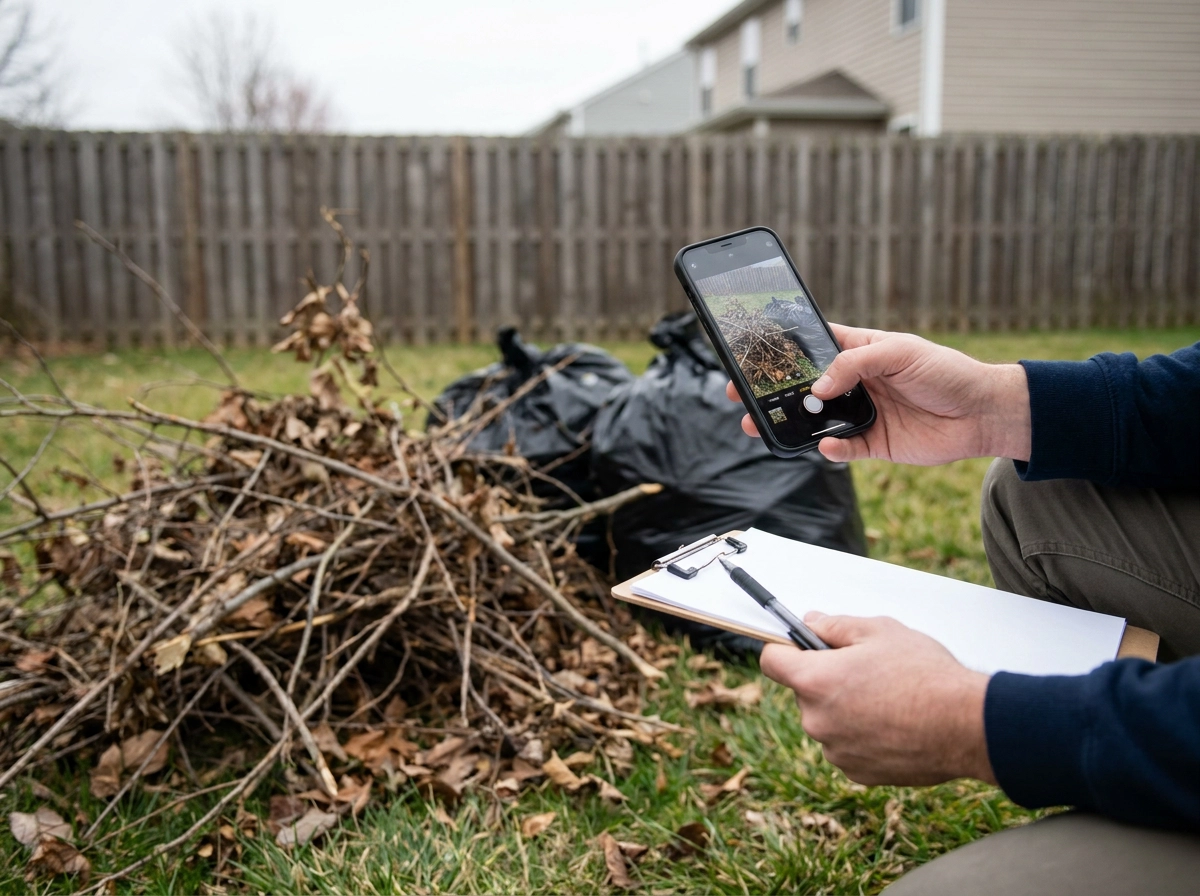
Before you call, document the job. Take photos of every debris pile, estimate volume in rough terms (number of bags, approximate size of the brush pile, or a rough cubic footage guess), and note any access restrictions such as narrow gates, soft ground, or limited driveway clearance. Providers who receive this upfront give more accurate numbers; providers who don't ask for it are guessing.
Be specific about debris type. "Tree limbs from a storm" routes to different disposal facilities and requires different labor than "seasonal leaf cleanup" or "mixed yard and construction debris." Naming the material precisely produces a meaningfully different estimate from any honest provider.
Ask directly whether the quote is all-inclusive. Confirm that labor, loading, haul-away, and disposal fees are all covered. Some quotes exclude dump fees or add trip charges separately, which changes the real cost significantly.
The most reliable way to close the gap between what you describe and what the crew finds is an on-site visit before pricing. A provider who sees the job has no reason to leave scope ambiguous. If you are planning a seasonal cleanup and want context on what that process typically involves, How to Get a Fall Cleanup Quote from The Pro Lawn walks through the specifics.
The Pro Lawn offers same-day quotes for yard debris removal across Hampton, Norfolk, Newport News, and Yorktown. Call 757-500-0532 for an accurate, on-site estimate with no contract required.
Getting the Right Price Starts With Understanding the Job
Once you understand what drives the price, the entire process becomes more manageable. Volume, debris type, property access, and urgency are the four variables that determine what any honest provider will charge. Know them before you call, and you control the conversation rather than reacting to a number you didn't expect.
Municipal curbside pickup in Hampton and Virginia Beach is worth using when your load is small and compliant. Bagged leaves, trimmed brush under six inches in diameter, proper placement timing: when those conditions are met, free service is the right choice. When they aren't, private removal is the practical solution, not a fallback.
The opening number on a quote matters less than what that number actually covers. A low bid that excludes disposal fees, assumes easy access, or stops when the truck is full costs more in the end than a complete, clearly scoped estimate from the start. Before accepting any quote, confirm that scope, completion, and haul-away are all included.
Seeing the job in person before pricing it is what separates a reliable estimate from a guess. An on-site, same-day quote closes the gap between what you describe and what the crew finds.
For homeowners across Hampton, Norfolk, Newport News, and Yorktown, The Pro Lawn provides yard debris removal with same-day quotes, no contracts, and scheduling built around your timeline. Call 757-500-0532 to get started.
Conclusion
Yard debris removal pricing is not arbitrary. Volume, debris type, property access, and scheduling urgency are the four factors that drive every honest quote. Free municipal pickup works when your load qualifies; private removal fills the gap when it does not. And the lowest bid is rarely the best deal when scope, hauling, and completion are left undefined.
Understanding these variables before you make a single call puts you in control of the outcome.
If you have storm damage, overgrown brush, or a cleanup project that has been sitting too long, the right crew and the right price are one conversation away. The Pro Lawn serves Hampton, Norfolk, Newport News, and Yorktown with same-day on-site quotes, no contracts, and flexible scheduling. Call 757-500-0532 today and turn that debris pile into a clean yard by end of week.
Ready for a healthier lawn?
Get a free quote from The Pro Lawn. Professional care for Hampton Roads.