
Blog
No-Contract Lawn Care: Why Hampton Roads Homeowners Are Ditching Annual Agreements
Annual lawn care contracts hide cancellation fees and unwanted add-ons. See why Hampton Roads homeowners prefer no-contract lawn service.
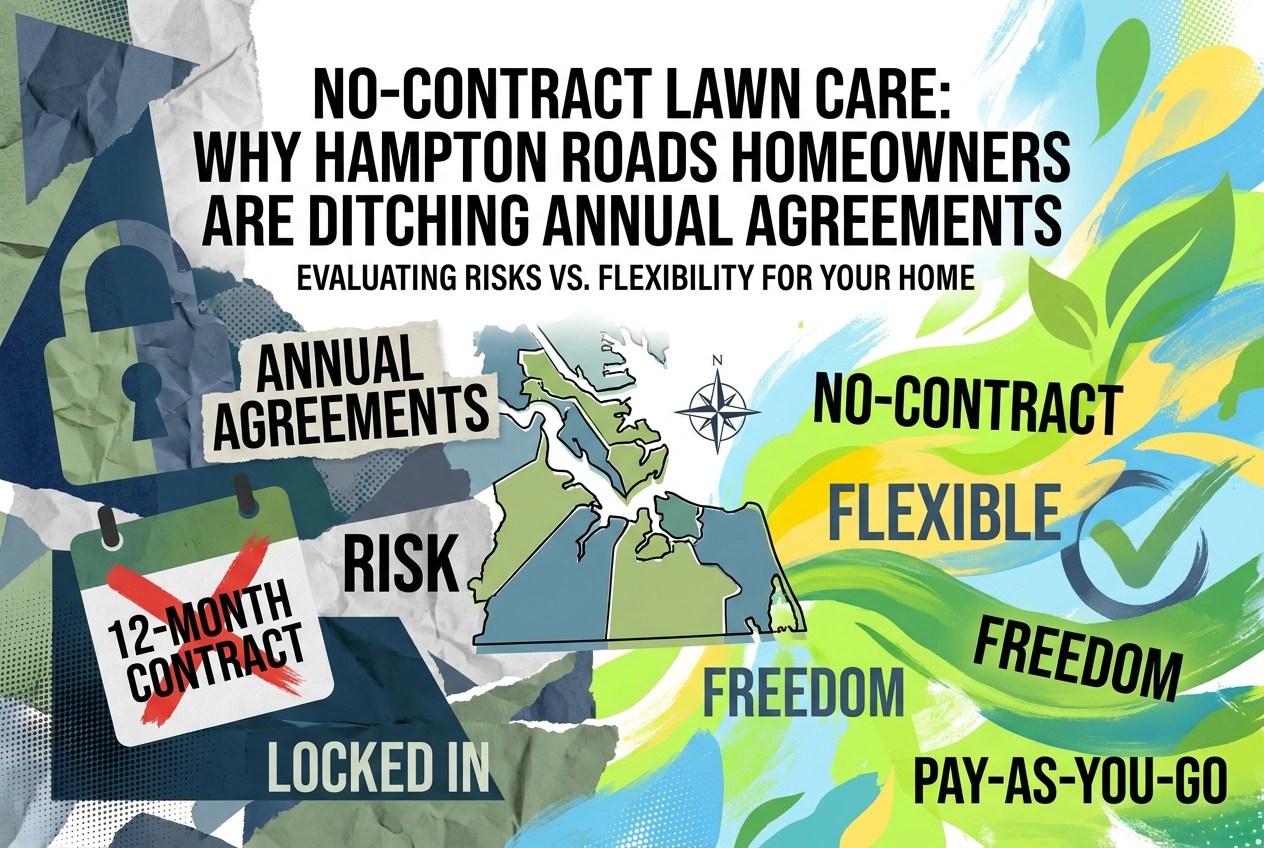
You signed up for lawn care to make your life easier. But somewhere between the sales pitch and the fine print, a lot of Hampton Roads homeowners find themselves stuck in agreements that work better for the company than for them.
Lawn maintenance contracts have quietly become the industry standard, and most people sign without fully understanding what they're agreeing to. Cancellation fees. Auto-renewals that kick in before you even notice. Bundled treatments you never asked for. Schedules that don't flex when your life does.
This post is going to walk you through all of it in plain language. We'll cover how these contracts became so common, what the hidden risks actually look like, and why the coastal climate and unpredictable seasons here in Hampton Roads make rigid agreements an even bigger problem than they'd be elsewhere. We'll also break down what a no-contract lawn care model genuinely delivers and what questions you should be asking before you hire anyone.
By the end, you'll have a clear picture of your options and the confidence to choose a lawn care setup that actually fits your needs.

How Annual Lawn Maintenance Contracts Became the Industry Default
Annual lawn care contracts weren't designed with homeowners in mind. They were designed to solve a business problem: how to smooth out revenue when grass grows fast in May and barely at all in January. Locking customers into a 12-month agreement protects the provider against slow seasons, cancellations, and scheduling gaps. That's good business strategy. It just isn't the same thing as good service.
As the industry grew, companies added fertilization, aeration, and pest control into bundled packages. The logic was straightforward: one customer paying for five services is more profitable than one customer paying for mowing alone. Whether you needed all five services was a secondary concern. The bundle became the default offer, and the contract became the mechanism that held it together.
Lawn care trade publications cover contract structures and cancellation terms as routine business topics, a signal that such penalties are treated as standard industry practice rather than a consumer concern. When penalties are considered standard, they exist to protect the company's revenue, not to reflect the quality of the service being delivered.
Most homeowners sign during a sales visit, which isn't the ideal environment for reading fine print. Auto-renewal clauses, notice-period requirements, and add-on service language tend to go unread until there's a reason to revisit the contract, usually when something goes wrong.
That friction reflects a gap between what the contract promises and what the homeowner actually experiences once they're locked in. Understanding why a no-contract model works structurally for homeowners starts with recognizing how the traditional model was built and who it was built to protect.
Cancellation Penalties: The Cost of Changing Your Mind
So you've signed the contract. Now circumstances change: you're moving, the mowing schedule never matched your lawn's actual growth, or the service just isn't working. You go to cancel, and that's when you find the early termination clause.
Early termination clauses in residential lawn care contracts can require homeowners to pay to exit before the term ends, terms that vary by provider but that the Florida Attorney General's office singles out as warranting careful consumer scrutiny. That penalty applies regardless of service quality. If your lawn is being cut on the wrong schedule, you still owe the balance.
Consumer protection regulators have taken notice. Florida's Attorney General has issued specific guidance warning consumers to read lawn service contracts carefully, including cancellation terms and extra charges. The FTC's cooling-off rule offers a narrow three-day window to back out after signing, but once that closes, you're bound by whatever the contract says.
Homeowners relocating, downsizing, or facing financial hardship face the identical penalty structure as everyone else. There is no standard hardship provision in residential lawn care contracts.
The imbalance runs one direction. A lawn care company can revise pricing or adjust service terms more easily than a homeowner can exit the agreement. That asymmetry is worth understanding before you sign anything.
Worth noting: the absence of a contract doesn't mean the absence of accountability. No-contract service can still mean consistent, reliable results, the difference is that the provider earns your business on every visit, not by making it costly to leave.
Bundled Services: Paying for What You Didn't Order
Cancellation penalties are one problem. But many homeowners never see the second one coming: the bill for services they never requested.
Most annual lawn care contracts don't sell you mowing. They sell you a package. Aeration, overseeding, fertilization, pest treatments, these get bundled into a single annual price whether your lawn needs them or not. You pay for the full package at signing, and the treatments get scheduled whether you asked for them or not.
For Hampton Roads properties specifically, this is a real mismatch. Lot sizes, grass types, and drainage conditions vary across Hampton, Norfolk, Newport News, and Yorktown. A bundled treatment plan built around a generic property profile often over-treats one yard and under-serves another. A smaller lot with warm-season turf doesn't need the same regimen as a larger shaded property a few streets away.
If all you want is recurring mowing and seasonal leaf cleanup, many contract providers simply don't have a trimmed-down option. It's the full package or nothing.
A no-contract model removes that forced trade-off. You can select exactly the services that fit your property, weekly or biweekly mowing, bush trimming, storm cleanup, and skip what you don't need. The Pro Lawn's frequently asked questions page outlines how that service selection actually works if you want specifics before calling.
Locked-In Schedules and Auto-Renewal Traps
Bundled packages aren't the only way a fixed contract works against you. The schedule itself can become its own problem.
Many annual lawn care contracts specify a fixed service frequency at signing, and the schedule is set regardless of whether your lawn's actual growth rate warrants it. Your lawn doesn't grow on a fixed calendar, though. Growth slows in dry stretches, speeds up after heavy rain, and changes entirely between seasons. A contract doesn't care. Visits keep coming, and bills keep arriving, whether the grass needed cutting or not.
Auto-renewal clauses compound this. Most contracts roll forward automatically for another full term unless you cancel within a specific window before the expiration date. Miss that window by a week and you're committed for another year. The FTC recognized this problem directly: its 2024 "Click-to-Cancel" rule was finalized specifically because cancellation barriers in recurring service agreements are a documented, widespread consumer harm.
The flexibility problem hits different homeowners differently. If you travel regularly, have a smaller yard that realistically only needs a biweekly cut, or want to pause service during a dry August, a fixed-schedule contract offers no adjustment. You pay for visits you didn't want and can't skip.
A no-contract provider eliminates this entirely. With straightforward pricing and flexible weekly or biweekly scheduling, you aren't locked into a cadence that stops fitting your lawn three months into the year. Service should follow your lawn's actual needs, not a calendar set at someone else's desk.
Why Contract Inflexibility Hits Harder in Hampton Roads
The scheduling problems covered above get worse when you factor in where you actually live.
Hampton Roads sees stretches of rapid grass growth, sudden dry spells, and a storm season that can send a tropical system through Hampton, Norfolk, Newport News, or Yorktown with little warning. A fixed weekly service schedule cannot account for any of that. After a storm drops debris across your yard, you need cleanup now, not on whatever day your contract says the crew shows up next.
Property variation adds another layer. A smaller lot in Hampton with sandy soil and light tree coverage has almost nothing in common with a heavily wooded Yorktown property that drains slowly after heavy rain. A one-size schedule that ignores turf type, tree coverage, and drainage characteristics will consistently over-serve some properties and under-serve others.
The coastal growth cycle is also genuinely uneven. Warm, wet stretches push grass fast enough that twice-weekly cuts might make sense. Then a dry period follows and weekly mowing produces nothing but unnecessary service calls billed to you at the contracted rate.
Storm debris and seasonal leaf accumulation create a separate problem: these needs fall outside most standard contract scopes. Homeowners often discover that leaf removal or storm cleanup triggers an extra charge on top of their contracted rate. Knowing when to schedule fall cleanup in Hampton Roads helps, but flexibility to act quickly matters more than having a date on a calendar.
A lawn care model built around how this region's weather actually behaves is not a luxury. It is the only model that fits.
What No-Contract Lawn Care Actually Delivers
So what does a no-contract model actually look like in practice? In straightforward terms, it shifts the accountability entirely onto the lawn care company. Without a penalty structure locking you in, the only thing keeping you as a customer is whether the work gets done right. That's a meaningful difference.
Scheduling flexibility is a direct extension of that accountability. Weekly or biweekly mowing plans let you match service frequency to how your lawn is actually growing, not to a calendar set months ago. When growth slows, you adjust. When it picks back up, you do the same.
Individual services work the same way. Bush trimming, leaf cleanup, and storm cleanup can be added when you need them and left off when you don't. There's no bundled package forcing you to absorb services that don't apply to your property this season.
Same-day quotes change the experience of hiring, too. You get a clear cost picture before any work begins, with no sales environment pushing you toward a signature. That kind of transparency is described in detail in what sets The Pro Lawn apart from other Hampton lawn services, including how the quoting and scheduling process actually works.
If the service isn't right for your property, you should be able to walk away without a penalty, and the next section covers exactly what to ask to confirm that before you sign.
What to Ask Before Hiring Any Local Lawn Care Company
Knowing what a no-contract model looks like makes it easier to spot the gaps when a company works differently. Before you hire anyone, ask these four questions directly.
"Is there a cancellation fee?" A reputable lawn care company answers this immediately and plainly. Hesitation or a vague "it depends" is a signal worth noting.
"Can I see the full contract before anything starts?" Read it specifically for three things: auto-renewal language, bundled service clauses, and how much advance notice you need to cancel. Note how much advance notice you need to cancel, and set a calendar reminder the day you sign.
"Does this quote cover exactly what I asked for?" Some quoted prices bundle in fertilization, aeration, or pest treatments you never requested. Confirm line by line that you're paying for services you actually want, not a package assembled for someone else's lawn.
"What happens if I need to skip a week?" If your lawn goes dormant during a dry stretch or grows slowly after a cool spell, you should be able to adjust without a penalty. A company that bills regardless of conditions is collecting for visits that don't serve your lawn.
These questions apply whether you're hiring for residential mowing or evaluating options for a larger property. For a deeper look at vetting providers for commercial work, the guide to choosing the right commercial lawn care company covers the same principles at a larger scale.
The Case for Keeping Your Options Open
Once you've asked the right questions, the answer usually points the same direction: a lawn care company that doesn't need a contract to keep your business is one that plans to earn it instead.
Annual lawn care contracts are structured around the provider's revenue, not your lawn. The penalties, auto-renewals, and bundled services covered throughout this post aren't accidental features; they're the architecture of a model designed to make staying easier than leaving. As the earlier sections document, regulators and legal platforms alike reflect how routine these disputes are.
As covered earlier, the coastal storm seasons and turf variability across this region make that mismatch worse than it would be in more uniform climates.
The Pro Lawn offers professional lawn care services built around what homeowners here actually need: recurring mowing plans, flexible weekly or biweekly scheduling, bush trimming, leaf cleanup, storm cleanup, and same-day quotes with no contract required. You choose what you need, when you need it.
Call 757-500-0532 to get a quote on your terms.
The right lawn care company keeps your business by doing good work. It shouldn't cost you anything to find out whether this one does.
Conclusion
You deserve a provider that earns your business through consistent results. The Pro Lawn offers no-contract lawn care across Hampton, Norfolk, Newport News, and Yorktown, with flexible scheduling and same-day quotes tailored to your property.
Call 757-500-0532 today and get a quote on your terms.
Ready for a healthier lawn?
Get a free quote from The Pro Lawn. Professional care for Hampton Roads.